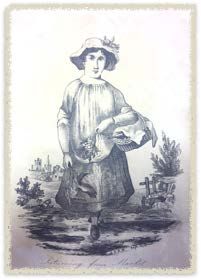
This pencil study Return from the Market was sketched by George Edwin Hartnoll Hogg and was found as a loose-leaf insertion in a book used as a teaching resource by the Manchester Institution for the Deaf and Dumb. It was acquired by the Deaf Museum & Archive.
Who was he?
 George E. H. Hogg was probably born deaf in Bideford, Devon, in February 1819. His father John Hogg was a chemist and a classical Latin scholar. At the age of eight he and his deaf brother John Jewell Hogg were educated at the West of England Institution for the Deaf and Dumb Exeter under the famed Henry Brothers Bingham. The school used a combined system and George was a pupil for seven years, excelling in arithmetic, and could mentally work out complicated numerical calculations in a short time. After Bingham became headmaster of the Manchester Institution for the Deaf and Dumb in 1834, Hogg joined his teaching staff two years later and stayed at the Institution as a teacher for 43 years and was its longest serving Deaf teacher. When the school decided to adopt the oral policy in 1879 Hogg resigned and became a lay-missioner in various towns in Lancashire. He lived at Sale in Cheshire with William and Sarah Cordingly, a Deaf farm labourer and his Deaf wife. William was a former pupil of George Hogg. In the 1891 census George is shown as living in Withington, Stretford, with another deaf couple, Ann and William Morton. At the late age
of 73 he married Louisa Williams, deaf dressmaker, aged 45 year old, born in Stockport in Shropshire in 1892. They moved to Macclesfield and then to Leicester where he died on 22nd April 1906 at the grand age of 86 years old.
 He excelled at pencil drawing but he was a brilliant arithmetician and had a remarkable talent for mental calculations, especially division and multiplication. Henry Brothers Bingham wrote a book about George’s mental calculations.
Photo of George Hogg: An Old Deaf Teacher, British Deaf Monthly, 1901, Vol. 10, p. 204
 The son of a pharmacist, Walter Geikie was born in Edinburgh on 9th November 1795 and became deaf just before his 2nd birthday when he contracted a serious fever that resulted in permanent hearing loss. (It could have been meningitis). He grew up deaf and dumb and his father could not afford to send him to deaf schools in the south of England so his father searched for guidance to educate his son. Fortunately he came across Joseph Watson’s book The Instruction of the Deaf and Dumb and used it to work tirelessly on Walter’s education, teaching him to communicate, read and write. His artistic ambitions emerged in his childhood, perhaps as a necessary means of self-expression. According to his biographer Thomas Dick Lauder he began drawing figures on the ground, walls, doors and pavements before he was given his first sketchbook. Again his family encouraged him and in 1812 he was admitted to the Trustees’ Academy of Edinburgh in which he received training from several tutors and he first exhibited in 1821. After that he soon began showing his artworks regularly. His works gained respect and were very well received and esteemed so much that he was elected to the Scottish Academy in 1831 and then in 1834 he was honoured by being elected as an Academician. It appears that he was colour blind. He received special training to do oils but these oil works were not so successful as his etchings.
 In this etching of a boy drawing on the floor a figure on horseback, making him the focus of attention with two seated adults looking on admiringly. Was it how Geikie remembered himself as a child, drawing on the floor as a part of his communication to get his message across? His brother had recalled that with Geikie “shut out from intercourse with boys of his own age, he found resources of his own, and getting chalk, began to draw figures on the floor, on doors, and any smooth surface within reach.” When his father became aware of Walter’s budding talent from observing his drawings on floor he gave his son pencils and a sketchbook.
 One would have thought he would do some drawings of deaf people socialising or going about with their daily lives but that was not detected in any of his works. Usually in hearing artists’ work their portraits of people would show their hands resting on their laps or holding something but in several of Walter’s works people were using their hands – were they signing?
 Thomas was born deaf in 1771 in Newent, Gloucestershire, the fourth son of six children of Nathaniel and Elizabeth Arrowsmith. His early years were described in the book The Art of Instructing the Infant Deaf and Dumb, published in 1819, the author being Thomas’ younger brother John. When he was about four or five, he was educated in a local hearing school at the insistence of his mother. At school he was taught to read and write but not to speak. He was able to attain a good command of written English. It is not known where he was educated after leaving the village school but it is believed that at the age of 12 or 13 he entered Braidwood’s Academy for the Deaf and Dumb in Mare Street, Hackney, London.
 He first exhibited at Somerset House in 1792. In later years he painted several of his teachers and fellow pupils. He was a prolific painter, doing many miniatures and the occasional large portraits. In 1812 he married Elizabeth Carpenter who may have been be deaf too. They went up North, living in various places such as Lancashire, Liverpool and Manchester. It is not known when Thomas died but it is believed that he died in 1829-30.
 Richard was the second son of John Crosse, a lawyer, and his wife Mary and was born in Knowle, near Cullompton, Devon, in 1742. He was privately educated as was his sister Alice who was also deaf. It is not known who educated them as unfortunately the family records were destroyed in a fire in the 1870s.
 He became such a prolific painter, painting hundreds of miniatures between one and half inches and six inches high. An illustration of how well educated he was can be seen in his ledger held by the Victoria and Albert Museum in London. In his ledger he meticulously recorded every painting he did and sold. His records show that he painted a total of 61 works in fewer than five months between 13th September 1776 and 30th January 1777, which earned him a total of £572, excellent money for his time.