Our copy in a gilt leather binding is of a rare book, The History of The Life and Adventures of Mr. Duncan Campbell , which is claimed to have been written by Daniel Defoe and it was published in 1720. It was about a “Gentleman, who, tho’ Deaf and Dumb, writes down any Stranger’s name at first sight; with their future Contingencies of Fortune.” The book was purchased in 1998 from Bernard Quaritch Ltd, antiquarian booksellers, by the BDHS.

Who was Duncan Campbell?
Duncan Campbell (1680?-1730) was a Scottish deaf man and an account of his early life claimed that he was brought up in Lapland where his Scottish father had wed a local woman. When his mother died, his father and his family returned to Scotland where he wed again. In the early 18thc. Duncan Campbell claimed to be deaf and to have magical fortune-telling powers, which was attracting a great deal of attention. He was described as a deaf mute who had learned to read following the method of John Wallis and made his name as a fortune-teller, dabbling in magic and 31 witchcraft. In 1694 he went to London where his predictions attracted attention in fashionable society. Running into debt, he went to Rotterdam where he enlisted as a soldier and returned to London after a few years. When having taken a house in Monmouth Street, he read a wealthy young widow’s fortune, to his own benefit, and he found himself again a centre of attraction. He also succeeded in obtaining the royal notice as it was reported in the Daily Post of Wednesday 4th May 1720: ‘Last Monday Mr. Campbell, the deaf and dumb gentleman—introduced by Colonel Carr— kissed the king’s hand, and presented to his majesty “The History of his Life and Adventures”, which was by his majesty most graciously received.’
In 1726 Campbell appeared as a vendor of miraculous medicines. He published The Friendly Dæmon; or, the Generous Apparition which consisted of two letters. In the first letter he wrote an account of his illness which had attacked him in 1717. He described how nearly eight years later, when his good genius appeared, it revealed that he could be cured by the use of the lodestone. The second letter was about familiar spirits, describing how a marvellous sympathetic powder had been brought back from the East. A postscript in the book informed the readers that ‘at Dr. Campbell’s house, in Buckingham Court, over against Old Man’s Coffee House, at Charing Cross, they may be readily furnished with his “Pulvis Miraculosus,” and finest sort of Egyptian loadstones.’ Campbell died after a severe illness in 1730.
The history of the life and adventures of Mr. Duncan Campbell has been frequently attributed to Daniel Defoe but there is little evidence that he wrote the book as the views expressed on the supernatural in the book directly contradicted arguments Defoe had presented elsewhere. Also Defoe was unlikely to have his book published by his enemy Edmund Curll, the book’s publisher. The book could be attributed to an anonymous writer, who was probably William Bond as he had then lived in the same house as Campbell in Exeter Court in the Strand.
The book has a fingerspelling chart and description shown between pages 38 and 39 and the fingerspelled alphabet depicted shows many similarities with the current BSL fingerspelling.


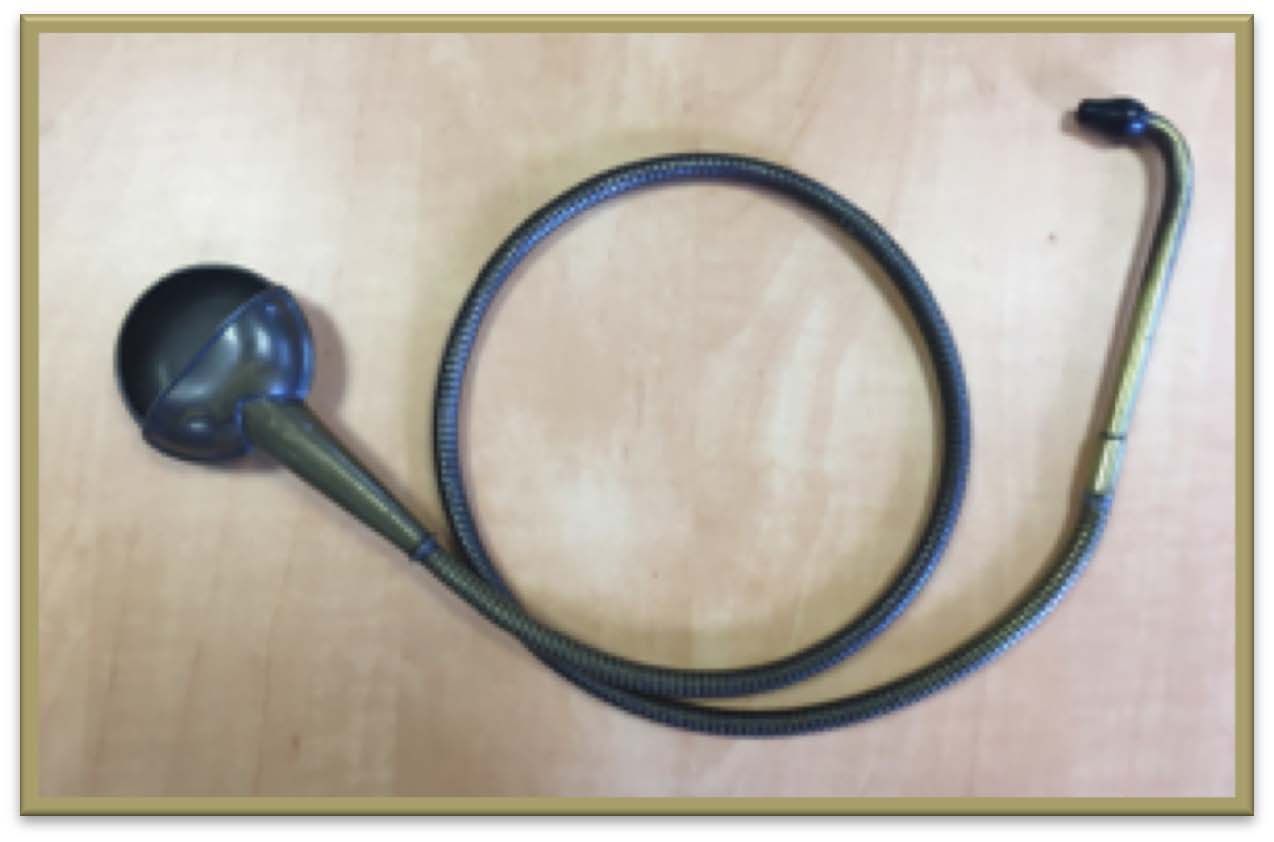 In the old days before the use of hearing aids people with hearing loss, especially when related to age, struggled to hear so all sort of devices were devised and invented.
 A large full-length Burwood Park School display noticeboard with gilt lettering showed the list of Head Boys, Captains of Football, Captains of Cricket and Victor Ludorum holders of the title from 1955/56 to 1987/88. It came to the Deaf Museum with a large number of other materials when the school closed in 1991. The Board is doubly used as an exhibit as well as a means of partitioning in the Museum.

 Born in Wakefield, Joseph Hepworth (1865-1921) was for a long time The British Deaf Times proprietor and editor. He lost his hearing when he was eight, but retained his speech. He also suffered from the additional problem of being almost blind but fortunately his blindness went. Joseph’s father George had a business making boilers. Joseph never went to a deaf school. When he was 22 he met a deaf house-painter and, knowing the manual alphabet, Hepworth conversed with him. “The Deaf man asked him which school he went to and this surprised Joseph, as he was 26 unaware that there were many other deaf persons around; he often assumed there were no more than a dozen deaf people in the whole of Britain!” This meeting led him to be more involved with people in the deaf community. Moving to Leeds, his eyes were opened to the educational needs of the deaf and he began to work for the missioner Mr Moreton. After his association with Moreton Joseph became an assistant missioner to the Bolton and District Deaf and Dumb Society. Then In 1896 he was appointed as Missioner to the Glamorgan and Monmouth Mission, with which he continued until his death.
 A Martin Dutton Yorkshire Oak Fruit Bowl hand tooled, the centre carved in relief with an armorial shield of three Tudor/Yorkshire style roses above a castle commemorating the 150 years (1829-1979) of The Doncaster School of the Deaf. He signed the bowl by carving a lizard on the outer edge of the bowl. Anthony Boyce donated the bowl to the Deaf Museum and Archive in 2011.


